If you have spent much time around backyard grilling, you have probably heard this rule:
“Do not cook over black charcoal. Wait until the coals ash over and turn gray.”
That advice is useful, but it is not universal.
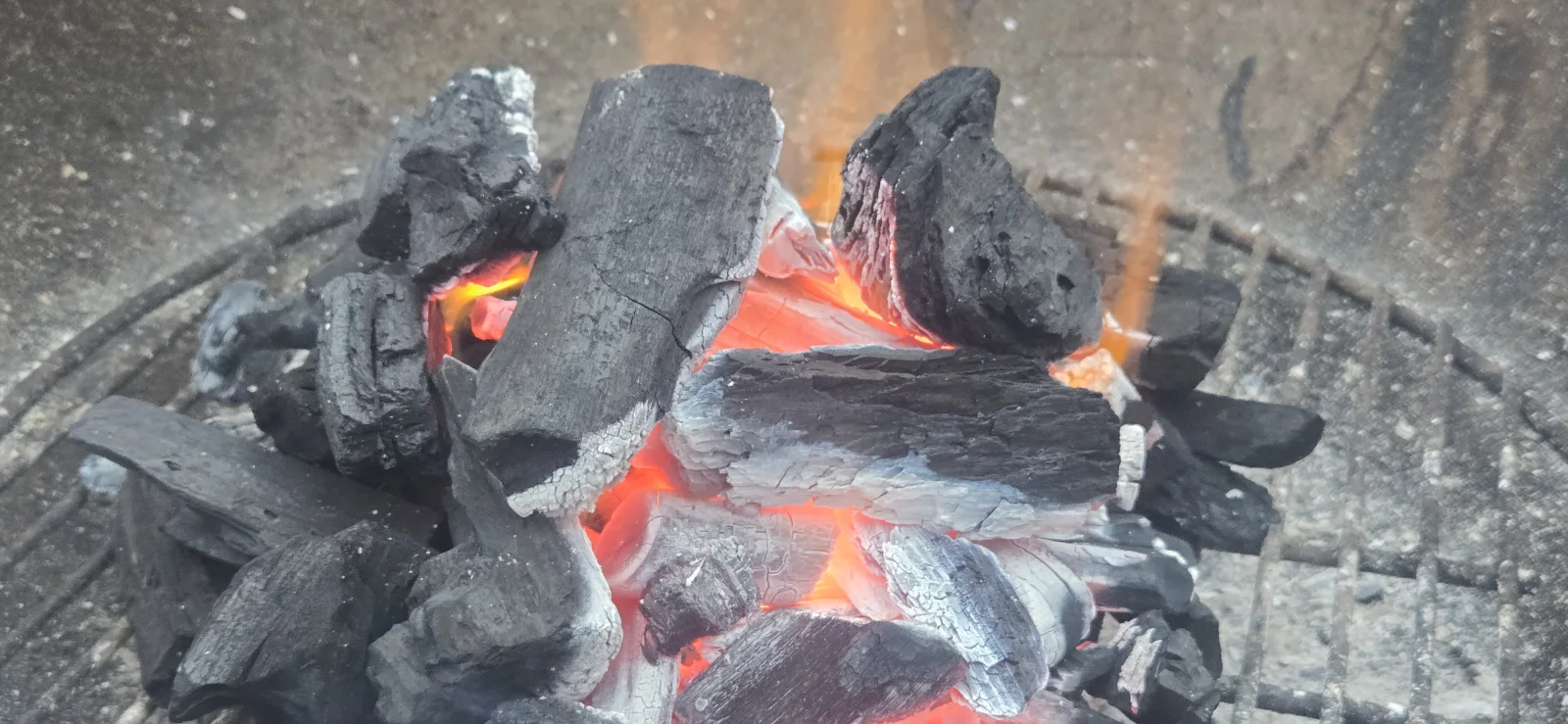
For direct grilling, waiting until the charcoal is mostly lit and covered with gray ash usually gives you a more stable fire. The harsh startup phase has passed, the heat is more predictable, and the charcoal is burning more evenly.
But low-and-slow barbecue often works differently.
In a Weber kettle, drum smoker, Weber Smokey Mountain, or charcoal cabinet smoker, cooks often load the cooker with unlit charcoal and then add a smaller amount of lit charcoal. The fire slowly spreads through the fuel over time. That is the basic idea behind the Minion method, snake method, and charcoal fuse method.
Offset smokers make the point even clearer. In a stick burner, you cook with a live wood fire and keep adding fresh splits throughout the cook. Those splits are not already burned down to white ash before the meat sees the heat and smoke.
So the real question is not:
“Is every piece of fuel gray?”
The real question is:
“Is the fire burning clean?”
The Gray Charcoal Rule Comes From Direct Grilling
The “wait until the charcoal turns gray” rule makes the most sense for direct grilling.
If you are cooking burgers, steaks, chicken pieces, sausage, or anything else directly over a hot charcoal bed, you usually want most of the charcoal fully ignited before food goes on. That gives you a cleaner, hotter, more stable heat source.
The rule gets misapplied when people treat it as a universal law for all barbecue.
Low-and-slow cooking is different because the fire is not always one fully lit pile of charcoal. It is often a controlled burn that moves slowly through the fuel.
That difference matters.
What the Minion Method Actually Does
In the Minion method, unlit charcoal is placed in the cooker, then a smaller amount of fully lit charcoal is added to start the burn. The lit charcoal slowly ignites the nearby unlit charcoal.
The snake method works on the same principle. Charcoal is arranged in a line or ring, one end is lit, and the fire gradually travels through the charcoal.
At first glance, this looks like cooking over unlit charcoal.
But that is not really what is happening.
A proper Minion or snake setup creates a small active fire front. Only part of the charcoal load is burning at any given time. The fuel ahead of that fire front is not suddenly igniting from dead cold. It is being warmed before it burns.
That preheating is important.
The Next Charcoal Is Already Being Preheated
In a charcoal snake or Minion setup, the charcoal next in line is being heated before it actively combusts.
The lit coals transfer heat by radiation, contact, and hot airflow. That nearby unlit charcoal gradually warms up. By the time the fire reaches it, the next briquette or lump is closer to ignition temperature than a cold pile of charcoal dumped into a cooker.
This matters because combustion quality depends on heat, oxygen, and fuel condition. When fuel is warmer and the fire has adequate oxygen, it can move into active combustion faster. When fuel is cold, damp, or oxygen-starved, it is more likely to spend time smoldering.
The science is not that “black charcoal is always fine.”
The science is that a controlled fire front can preheat the next fuel and ignite it gradually, instead of forcing a large cold fuel bed through startup all at once.
Charcoal Is Not Raw Wood
Another reason the gray-charcoal rule gets oversimplified is that people talk about charcoal like it is raw wood.
It is not.
Charcoal is already a processed fuel. It has been made by heating biomass under limited oxygen, driving off much of the water and volatile material and leaving a carbon-rich solid fuel. That does not make all charcoal equal, but it does make charcoal different from throwing raw wood into a firebox.
Charcoal quality still matters. Commercial lump charcoal and briquettes can differ by raw material, production method, ash content, density, and other properties. Research on grilling emissions has found that charcoal quality can significantly affect combustion properties and pollutant emissions [1].
Another grilling emissions study measured total volatile organic compounds and total suspended particles while cooking meat over lump charcoal and briquettes, showing that fuel type and cooking conditions can affect what comes off the grill [2].
So the correct lesson is not “all charcoal is clean.”
The correct lesson is:
Use good fuel, give it enough oxygen, and manage the fire so the next fuel ignites cleanly instead of smoldering.
Clean Fire Depends on Oxygen, Heat, and Fuel
Combustion is controlled by fuel, heat, and oxygen.
When a fire has enough heat and oxygen, more of the fuel can oxidize cleanly. When oxygen is limited, combustion becomes less complete and can produce more carbon monoxide and soot instead of fully oxidized combustion products [3].
That is why choking a cooker too hard can create bad smoke.
A low fire is not automatically a dirty fire. A small, hot, well-ventilated fire can burn clean.
But a suffocated fire is different. If the intake is choked too hard, the exhaust is restricted, the fuel is damp, or the fuel load is too large for the available airflow, the fire can smolder. Smoldering combustion is associated with a different burn behavior than flaming combustion, and wood science sources describe smoking and smoldering as combustion occurring in pyrolyzing material rather than a clean flame front [4].
For barbecue, that distinction matters more than the color of the charcoal.
Good smoke comes from controlled combustion.
Bad smoke comes from smoldering, stale, oxygen-starved combustion.
What About Wood Chunks in Charcoal?
Wood chunks add another layer.
In a kettle, drum, or cabinet smoker, cooks often place dry wood chunks among the charcoal. As the charcoal fire reaches the wood, the wood heats, releases gases, and burns or smolders depending on the temperature and oxygen available.
Wood does not simply burn as a solid. When wood is heated, it thermally decomposes and releases volatile compounds and tarry products. Those gases and vapors can burn in the gas phase, while the remaining char can continue glowing or smoldering depending on the oxidation rate [5].
That is why wood chunks behave differently depending on the fire.
A small amount of dry wood in a hot, breathing charcoal bed can produce clean smoke.
Too much wood, wet wood, buried wood, or oxygen-starved wood can produce heavy white smoke and bitter flavor.
The issue is not whether the wood was already on fire before the meat went on.
The issue is whether the wood is being heated and burned in a clean combustion environment.
Offset Smokers Prove the Rule Is Not Universal
Offset smokers are the clearest proof that “only cook over fully ashed fuel” is not a universal barbecue rule.
In an offset, you cook with a live fire and keep adding fresh wood splits during the cook. Those splits are not pre-burned to white ash before the meat is exposed to the smoke.
The reason it works is that a properly managed offset has a hot coal bed, dry wood, and enough airflow.
When a fresh split lands on a hot coal bed, it heats quickly. The wood begins thermal decomposition, releases combustible gases, and those gases can ignite and burn when the firebox has enough heat and oxygen [5].
That is clean stick-burning.
The problem is not fresh wood.
The problem is fresh wood that smolders.
A weak coal bed, oversized split, damp wood, or restricted airflow can cause the split to blacken and smoke without burning cleanly. Studies of wood combustion under varying moisture contents show that moisture content changes combustion behavior, including thermal behavior, burn rate, and the sustainability of combustion [6].
That matches what experienced offset cooks already know from practice: dry splits burn better, wet splits fight the fire.
Preheating Splits Helps for the Same Reason
Many offset cooks warm their next split on top of or near the firebox before adding it.
That is not just tradition. It makes combustion sense.
A preheated split enters the firebox warmer than a cold split. That means less energy from the fire has to be spent warming the wood and driving off surface moisture before the split can ignite.
This is the same principle as a charcoal snake.
In a charcoal snake, the next section of charcoal is being warmed before the fire reaches it.
In an offset, the next split can be warmed before it lands on the coal bed.
In both cases, preheating helps the next fuel move toward ignition faster.
But preheating is not magic. It does not make wet wood good. It does not fix a weak coal bed. It does not replace airflow. It simply gives the next piece of fuel a better start.
Fresh Fuel Is Not the Enemy
The wrong lesson is:
“Never let fresh fuel ignite while food is cooking.”
That is not how many long barbecue cooks work.
The better lesson is:
“Do not let fresh fuel smolder in a cold, oxygen-starved fire.”
In a good Minion setup, fresh charcoal ignites gradually from an established fire.
In a good snake setup, the fire front moves slowly through preheated charcoal.
In a good offset, fresh wood ignites on a hot coal bed with enough oxygen.
In a bad setup, cold or damp fuel is added to a weak fire, airflow is restricted, smoke gets stale, and the meat is exposed to dirty combustion.
Same general fuel category.
Very different fire quality.
How to Read Your Fire
Do not judge the fire only by whether every coal is gray.
Judge it by combustion quality.
Good signs:
- Thin, light smoke
- Clean wood or charcoal smell
- Stable cooker temperature
- Active combustion instead of lazy smoldering
- New charcoal or wood catches without a long dirty smoke phase
- Exhaust is moving instead of trapped and stagnant
- Fuel is dry and properly sized
- Airflow is controlled, but not suffocated
Bad signs:
- Thick white, gray, or yellowish smoke that keeps rolling
- Bitter, sharp, chemical, damp, or stale smell
- Wood blackening without flame
- Charcoal struggling to catch
- Firebox packed too full
- Intake and exhaust restricted too aggressively
- Black soot collecting on food or cooker surfaces
If the smoke smells bad, it will probably taste bad.
Plain Charcoal Versus Instant-Light Charcoal
This distinction matters.
The Minion method, snake method, and other controlled-burn charcoal methods should be done with plain charcoal, not lighter-fluid-soaked charcoal or instant-light briquettes.
The reason is practical. In these methods, fresh charcoal ignites throughout the cook. If the charcoal contains added ignition fluid, the food can be exposed to that startup phase repeatedly as the burn progresses.
Use plain briquettes or good lump charcoal. Light the starter coals separately in a chimney. Add those lit coals to the unlit charcoal setup. Let the cooker settle into a clean burn before loading the meat.
The Practical Rule for Charcoal Cookers
For direct grilling, wait until your charcoal is mostly lit and ashed over.
For low-and-slow barbecue, unlit charcoal can be part of a clean controlled burn if the setup is managed correctly.
Use plain charcoal. Start with fully lit coals. Let the cooker stabilize. Keep the exhaust open. Do not choke the fire into smoldering. Use dry wood chunks sparingly. Watch the smoke. Smell the exhaust.
The goal is not to make every piece of fuel gray before the meat goes on.
The goal is to run a small, clean, stable fire that lights the next fuel gradually.
The Practical Rule for Offset Smokers
For offsets, the same clean-fire principle applies, but wood management matters even more.
Run a small, hot fire. Maintain a good coal bed. Use dry, seasoned splits. Add one properly sized split at a time. Let the wood ignite instead of smolder. Keep enough airflow moving through the firebox and cook chamber.
If a new split gives a short puff of heavier smoke, that is normal.
If it keeps smoldering and pouring dirty smoke, something is wrong.
Usually the split is too cold, too wet, too large, or the fire does not have enough oxygen.
Preheating the next split helps. A strong coal bed helps more. Proper airflow matters most.
An offset is not supposed to be a smoke machine. It is supposed to be a clean-burning wood-fired oven.
Final Answer: Is It Okay to Cook With Unlit Charcoal in the Grill?
Yes, if you are using plain charcoal in a controlled low-and-slow setup with good airflow and a clean-burning fire.
No, if you are using instant-light charcoal, lighter fluid, damp fuel, restricted airflow, or cooking in thick startup smoke.
The old rule says:
“Wait until the charcoal turns gray.”
The better rule says:
“Cook over a clean fire.”
Gray charcoal is a useful visual cue for direct grilling. But in low-and-slow barbecue, the better standard is clean combustion.
A charcoal snake works because the next fuel is preheated and ignites gradually.
The Minion method works because a small live fire slowly spreads through the charcoal bed.
An offset works because fresh wood burns cleanly when it is added to a hot coal bed with enough oxygen.
Fresh fuel is not automatically dirty.
Smoldering fuel is.
That is the difference between good smoke and bad smoke.
References
- Charcoal quality and emissions. Mencarelli, Greco, and Grigolato, Grilling and air pollution: how charcoal quality affects emissions. This source supports the claim that commercial lump charcoal and briquettes differ by raw materials and production methods, and that charcoal quality can significantly affect combustion properties and pollutant emissions.
https://link.springer.com/article/10.1007/s11869-025-01737-0 - Lump charcoal vs. briquettes, VOC and particle emissions. This study quantified total volatile organic compounds and total suspended particle emissions during grilling with lump charcoal and briquettes across chicken breast, pork belly, and beef steak.
https://pmc.ncbi.nlm.nih.gov/articles/PMC13013268/ - Oxygen limitation and incomplete combustion. This chemistry reference supports the basic combustion claim that complete combustion occurs with excess oxygen, while limited oxygen produces incomplete combustion products such as carbon monoxide and soot.
https://www.chemistrystudent.com/ib-dp/r1.3-energy-from-fuels/incomplete-combustion-1-3-2.html - Smoldering and continuous smoke. The USDA Forest Products Laboratory wood fire chapter describes continuous smoking as visual evidence of smoldering in pyrolyzing material.
https://www.fpl.fs.usda.gov/documnts/pdf2016/fpl_2016_dietenberger001.pdf - Wood pyrolysis, volatile gases, char, flaming, and smoldering. The USDA Forest Products Laboratory chapter on thermal properties and combustion of wood explains that wood decomposes into volatile/tarry products and reactive char, with gas-phase oxidation producing flames and solid-phase oxidation producing glowing or smoldering combustion depending on oxidation rate.
https://www.fpl.fs.usda.gov/documnts/pdf2013/fpl_2013_rowell001.pdf - Wood moisture and combustion behavior. A wood-combustion study using oak samples from 0% to 30% moisture content found that higher moisture levels affected fuel consumption and combustion sustainability.
https://eprints.whiterose.ac.uk/id/eprint/233455/
Keep learning