What It Is, Why It Happens, and How to Get Through It
If you cook brisket, pork butt, or any other large cut long enough, sooner or later you are going to run into the stall. It is one of the most frustrating parts of barbecue because it makes people think something has gone wrong when, in reality, the cook is often progressing exactly the way it should.
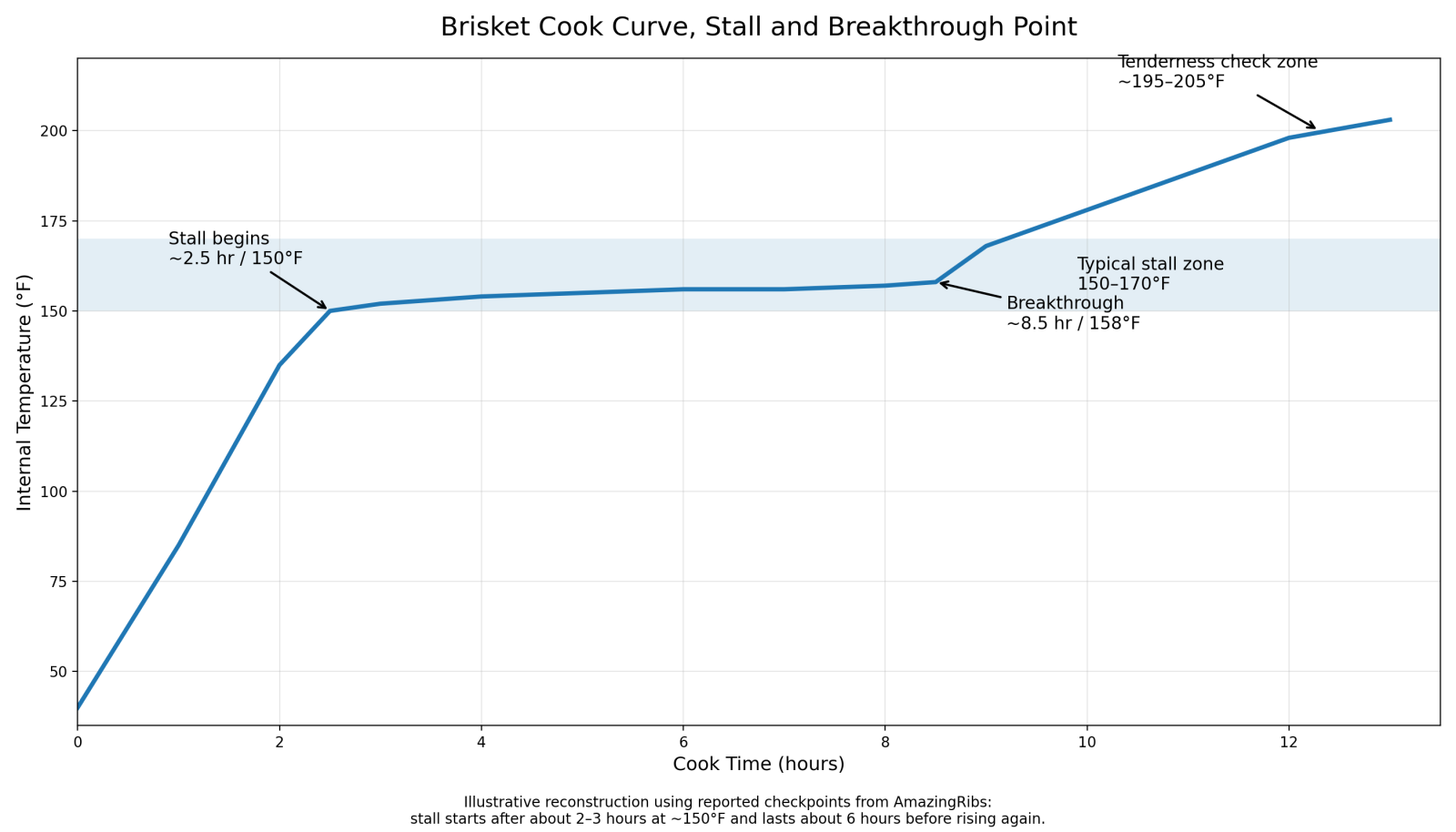
Your pit temperature is steady. The fire is clean. Everything looks good. Then the internal temperature of the meat just stops moving. Sometimes it seems parked in the mid 150s for what feels like forever. That is the stall.
The good news is that the stall is not a mystery, and it is not a sign that your smoker suddenly quit doing its job. It is a normal part of low-and-slow cooking on larger cuts of meat. The key is understanding what is actually happening so you do not make bad decisions in the middle of the cook.
What the Stall Actually Is
As meat cooks, heat moves inward from the surface. At the same time, moisture inside the meat moves toward the outside. When that moisture reaches the surface and evaporates, it carries heat away. For a while, that cooling effect can be strong enough to nearly cancel out the heat coming in from the smoker. When that happens, the internal temperature rise slows to a crawl or seems to stop completely. That is the stall.
If that sounds familiar, it should. It is the same basic principle as sweat cooling your skin. Evaporation takes energy. In barbecue, that energy is heat that would otherwise be helping push the internal temperature of the meat upward.
On large cuts like brisket, the stall often shows up somewhere around 150 to 170°F internal, though that range is not fixed. The exact timing and duration depend on the size of the cut, pit temperature, airflow, humidity, fat cover, and how much moisture is available to keep evaporating from the surface.
The Food Science Behind It
This is where a lot of barbecue talk gets sloppy.
People often say the stall happens because collagen is breaking down. That explanation is incomplete at best, and misleading when presented as the main cause. Collagen breakdown matters for tenderness, but evaporative cooling is the stronger explanation for why the temperature plateaus.
As meat heats up, proteins denature and muscle structure changes. Those changes affect how well the meat holds onto water. As water-holding capacity drops, more moisture moves toward the surface. The more moisture that can evaporate, the more heat gets pulled away from the meat, and the longer the stall can hang on.
Collagen still matters, just not in the lazy way it often gets explained. Collagen and connective tissue changes are more important to the final tenderness of brisket than to causing the stall itself. That distinction matters because it helps explain why the stall is really a heat-and-moisture balance problem, not the meat somehow pausing while collagen melts.
Why the Stall Feels So Bad
The stall messes with people because it looks like something is wrong.
You can do everything right, then the thermometer seems frozen, not moving . That is when beginners start making mistakes. They crank the heat too high, keep opening the lid, move probes around, or panic and pull the meat too early. None of those reactions help.
The reality is that the stall is not a warning sign. It is simply one stage of the cook. Once you expect it, it loses a lot of its power to make you second-guess yourself.
How to Get Through the Stall
There are three legitimate ways to handle it, and each one has tradeoffs.
1. Wait It Out
This is the no-wrap approach. You keep the pit running steady and let the meat work through the stall on its own.
The upside is bark. Leaving the meat exposed helps preserve and deepen that crusty exterior everyone wants on brisket. You also keep the surface in the smoke stream the entire time.
The downside is time. Waiting out the stall can add hours to the cook, especially on a full packer brisket. If bark is your top priority and you do not care about speed, this is the cleanest route.
2. Wrap the Meat
Wrapping is the classic way to push through the stall faster. Whether you use foil or butcher paper, the basic idea is the same, reduce evaporation at the surface so the meat stops losing so much heat.
That is why wrapping works. You are not magically forcing the brisket to cook. You are reducing the cooling effect that has been holding it back.
Foil is faster because it traps moisture more aggressively, but it softens bark more. Butcher paper is a middle-ground option. It still helps shorten the stall, but it breathes more and usually preserves bark better than foil.
This is exactly why the stall article connects cleanly to your wrap or no wrap piece. Wrapping is not just a style choice. It is a response to the physics of the cook.
3. Raise the Pit Temperature
Another way through the stall is to increase cooker temperature. Moving from 225°F to something in the 250 to 275°F range gives the smoker more heat input to overpower the cooling effect of evaporation.
This does not eliminate the stall in some magical way, but it can shorten it. Many experienced cooks run hotter than beginners expect for exactly this reason. The tradeoff is that you narrow your margin for error a little, especially if your cooker runs uneven or tends to spike.
Still, a modest increase in pit temperature is often a smarter move than sitting at a low temp for hours while wondering why nothing is happening.
What Not to Do
The worst thing you can do during the stall is panic.
Do not keep opening the lid every few minutes. Every time you open the cooker, you dump heat and disrupt the environment you are trying to maintain. Do not jack your temperature wildly up and down. Do not assume the meat is done just because it has been sitting in the same range for a long time.
The stall is not the finish line. It is just one phase of the cook.
Safe Temperature Is Not the Same as Tender
This is another place where people get confused. Food safety temperature and barbecue doneness are not the same thing.
For whole cuts of beef, the current safe minimum internal temperature is 145°F with a 3-minute rest. That is a food safety threshold, not a brisket tenderness target. Brisket is usually nowhere near done in the barbecue sense at 145°F.
Barbecue cooks keep going well beyond that because tenderness depends on what has happened to the structure of the meat over time, not just whether it has crossed a minimum safe temperature. That is why good brisket cooks finish by feel, not by blindly chasing a number.
The Real Lesson
The stall is not a problem to fear. It is a process to understand.
Once you know that the plateau is driven mainly by evaporative cooling, the whole thing starts making sense. The meat is still cooking. Heat is still entering it. It just is not gaining internal temperature quickly because it is shedding heat through evaporation at nearly the same time.
From there, the choices become simple.
- If bark matters most, wait it out.
- If time matters most, wrap.
- If you want a middle ground, raise the pit temperature.
What you should not do is mistake the stall for failure. It is not failure. It is barbecue doing what barbecue does.
Final Thought
A lot of bad barbecue advice survives because it sounds simple. Saying the meat stalled because the collagen started melting sounds neat and tidy, but it skips over the more useful truth. The stall is really about heat transfer, moisture movement, and evaporation. Understanding that makes you a better cook because it gives you a reason for your decisions instead of leaving you at the mercy of old pit myths.
Sources
Keep learning