Brining for BBQ… dry vs wet, safety, and curing salt
If Maillard is how you build flavor on the outside… brining is how you protect the inside while you chase that crust.
Brining is one of the most misunderstood "simple" techniques in BBQ. Some people swear it turns everything into juicy magic. Others swear it makes meat taste like deli ham. Both are right, depending on how it's done.
This post breaks brining down in practical terms for backyard cooks, and gives enough control knobs for the competition crowd to actually use it on purpose.
What brining really does
Brining is a salt driven change to meat. Salt does three big things: it seasons deeper than the surface, it changes proteins so the meat holds onto more water during cooking, and it changes how the surface behaves, which affects browning and texture.
If you've ever had pork chops that eat like cotton, chicken breast that tastes dry even when it hit the right temp, or turkey that needs gravy to survive… brining is one of the best fixes.
But it's not magic. It's a controlled process, and too much time, too much salt, or poor temperature control turns it into salty, mushy, hammy meat.
Dry brine vs wet brine
Dry brine
This is salt applied directly to the meat, then left to rest. That's it.
What happens: salt pulls moisture out at first, that salty moisture dissolves the salt, then it gets pulled back into the meat over time carrying seasoning with it, and the surface ends up drier than it started, which helps browning.
Why BBQ people love it: better browning, better bark, better skin. Less water introduced means less "wet surface" fighting Maillard. And it's simpler with no bucket of liquid in your fridge.
Wet brine
This is meat soaked in salt water, usually with sugar and aromatics.
What happens: the brine seasons the outer layers, meat absorbs some water along with salt, and it can help lean meat stay juicier, but it also increases surface moisture.
Why BBQ people use it: poultry, especially whole birds, can benefit a lot. Turkey breast, chicken breast, pork loin… wet brine can be forgiving. It's great when you want a very even, mild seasoning and a juicier bite.
The trade-off: wet brine can soften bark and fight crisp skin unless you dry the surface before cooking.
One default rule
Use dry brine for beef, pork shoulder, ribs, lamb, and most "bark" cooks. Use wet brine for poultry, lean pork, and seafood when you need extra forgiveness.
Time, temperature, and humidity… safety and results
This matters more than the recipe.
Temperature… keep it cold
Raw meat sitting in salted water is still raw meat. Salt slows some bacterial growth, it does not make it safe at room temperature.
Keep brining at 40°F or colder, in the refrigerator. USDA brining guidance for turkey calls out keeping the bird and brine refrigerated at 40°F or less, and not brining longer than about two days for large poultry.
Quick safety rule for your kitchen: If it's not in the fridge… it's not brining, it's gambling.
Humidity… it changes your results after the brine
Humidity is not just a smoker topic. It affects what happens next.
After a wet brine, the surface is wet. If you go straight to the cooker, the surface temp stalls near the boiling point of water, browning slows, chicken skin stays rubbery, and bark takes longer to set.
What fixes it: air drying. Pat dry, then let the meat sit uncovered on a rack in the fridge to dry the surface before cooking.
This is the link between brining and Maillard. If you want crust and bark, you need a surface that can dry and heat up.
The "danger zone" and time
Food safety guidance commonly uses 40°F to 140°F as the danger zone range where bacteria grow quickly. Your brine belongs below that.
Common brine ratios by protein
The cleanest way to talk brines is by weight, not cups and spoons, because salt brands and crystal sizes vary.
Two core numbers to know
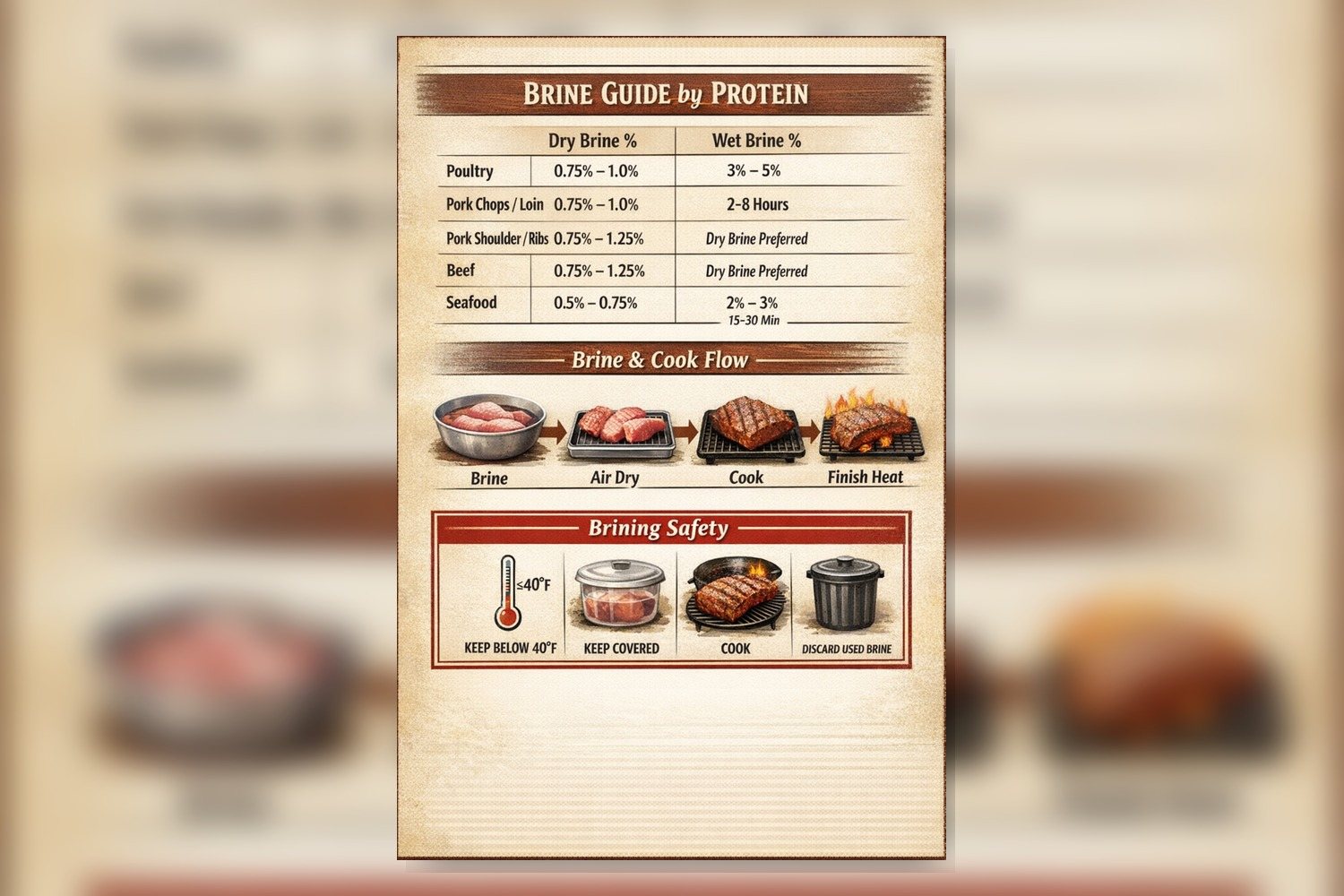
Dry brine, salt as a percent of meat weight: typical working range is 0.75% to 1.25% salt by weight. Example: 1000g meat, use 7.5g to 12.5g salt. This is a strong, practical range for BBQ without pushing "hammy."
Wet brine, salt concentration in the water: typical working range is 3% to 6% salt by weight in the brine. Example: 1 liter water (1000g), use 30g to 60g salt. Lower end is gentler, higher end is faster and can get salty.
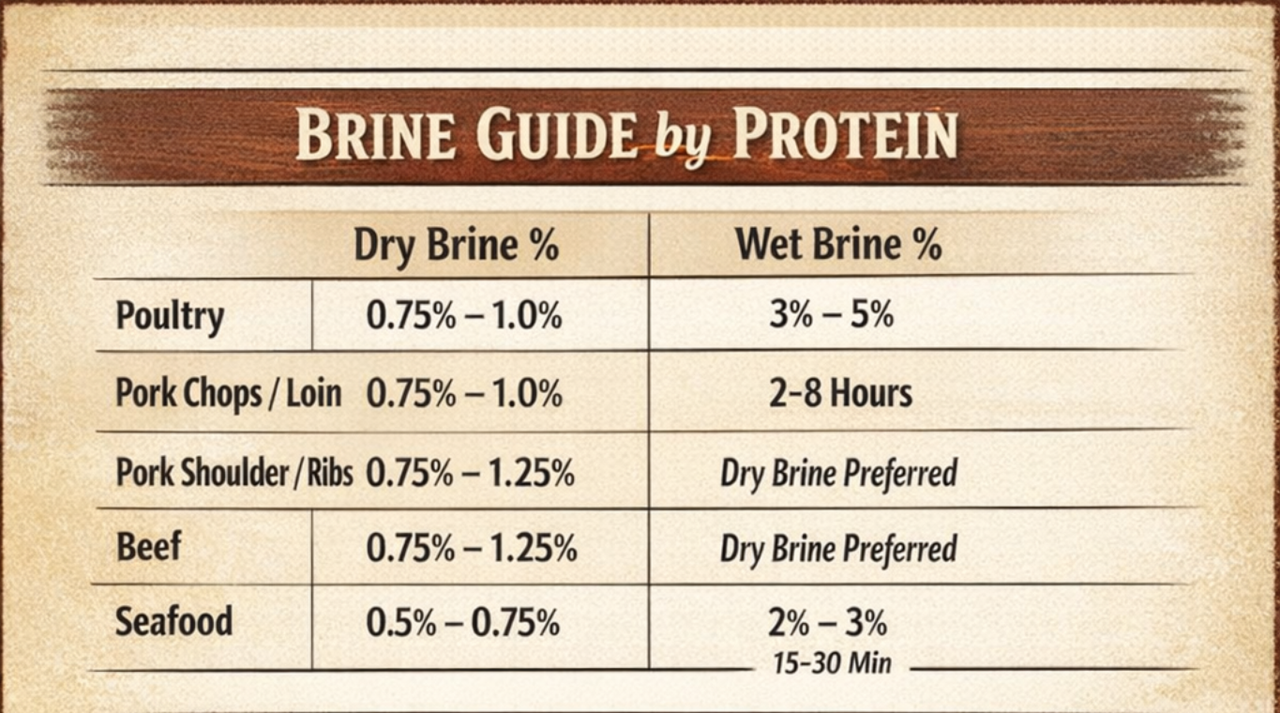
Quick reference guide for brining ratios by protein type
Poultry
Dry brine: 0.75% to 1.0% salt by weight, 8 to 24 hours uncovered in the fridge. Skin dries and browning improves.
Wet brine: 3% to 5% brine. Pieces need 2 to 6 hours, whole chicken needs 6 to 12 hours, and whole turkey needs 12 to 24 hours. USDA notes keeping brined poultry refrigerated, and not exceeding long brine holds, especially for large birds.
Pork chops, tenderloin, loin
Dry brine: 0.75% to 1.0%, 4 to 12 hours.
Wet brine: 3% to 5%, 2 to 6 hours for chops, 4 to 8 hours for loin. Long soaks can push "cured" texture on lean pork, so don't go wild.
Pork shoulder, ribs
Most of the time… dry brine wins. Use 0.75% to 1.25%, 12 to 24 hours. You're building bark here. Wet brine is usually fighting your end goal unless you have a specific reason.
Beef steaks, roasts
Dry brine: 0.75% to 1.25%. Steaks need 4 to 24 hours, roasts need 12 to 48 hours. This is one of the easiest crust upgrades you can do.
Wet brine on beef: not common for BBQ, mostly used for things like corned beef style results, or when you intentionally want a cured vibe.
Lamb
Dry brine: 0.75% to 1.25%, 4 to 24 hours depending on thickness. Lamb browns beautifully, dry brine supports crust without washing out flavor.
Seafood
Be careful, short and gentle.
Dry brine: 0.5% to 0.75%, 15 to 45 minutes, depending on thickness. Great for salmon portions before grilling, it firms the surface and helps sear.
Wet brine: 2% to 3%, 15 to 30 minutes for shrimp and thinner fish. Seafood can turn rubbery if you overdo salt time.
Flavor add-ins that actually work
You can add flavor to brines, but keep your expectations realistic. Brines mainly move salt and water. Aromatics mostly stay near the surface. That's fine, surface flavor matters, especially on poultry and pork loin.
Sweet support
Brown sugar, honey, maple, and sorghum add balance and help browning, especially when you finish hot.
Acid, use lightly
Citrus peel, a little vinegar, or a little hot sauce can help flavor, but heavy acid can change texture fast, especially on poultry and seafood.
Herb and spice
Bay leaf, black pepper, garlic, thyme, and rosemary show up best on poultry and pork.
BBQ forward combos
Poultry brine: 4% salt brine with a little brown sugar, garlic, black pepper, and bay. Then air dry overnight for crisp skin.
Pork loin brine: 4% salt brine with apple cider, a little brown sugar, black pepper, and garlic. Then pat dry and run a hot finish.
Salmon quick brine: 2.5% salt brine with a little brown sugar, 15 to 25 minutes. Then rinse fast, pat dry, let it tack up, then sear.
Pink salt, Prague powder, nitrate and nitrite safety
This section matters, because people confuse three different things: Himalayan pink salt, which is just salt, not a curing salt; pink curing salt, also called Prague Powder #1 or Cure #1; and Cure #2, used for long dry curing.
What Prague Powder #1 is
Prague Powder #1 is typically 6.25% sodium nitrite and 93.75% salt, dyed pink so nobody mistakes it for table salt.
Why it exists
Nitrite is used to control risk in cured meats, and it creates that classic cured color and flavor.
When you should use it in BBQ
Only when you are intentionally making a cured product like bacon style pork belly, corned beef style brisket, or cured, smoked sausages. You do not use curing salt for a normal wet brine on chicken, ribs, pork butt, steak, or seafood.
Cure #1 vs Cure #2
Cure #1 is for short cures that will be cooked, smoked, or otherwise finished in a reasonable time. Cure #2 includes nitrate intended for long dry curing where it converts over time, think traditional dry cured salami. If you are not doing long dry curing, do not use Cure #2.
The critical safety rule
Measure curing salts by weight, not by "looks about right." Regulatory and inspection resources emphasize limits and calculations for nitrite and nitrate in meat products, and exceeding allowable in-going nitrite is treated as noncompliant.
A practical home rule for Cure #1
Many curing processes aim for around 156 ppm in-going nitrite for a lot of cured meat applications, and Cure #1 is formulated so small, precise amounts hit those ranges when calculated correctly. The FSIS calculation handbook and quick reference show the framework for calculating ppm from the nitrite content in curing compounds.
Plain language warning
Too little curing salt can mean you did not accomplish the safety goal you thought you did. Too much can be harmful, and it can also ruin the food. Keep it labeled, keep it away from kids, and never treat it like regular salt.
BBQ specific moves… bark, skin, smoke, finishing heat
Brining plus bark
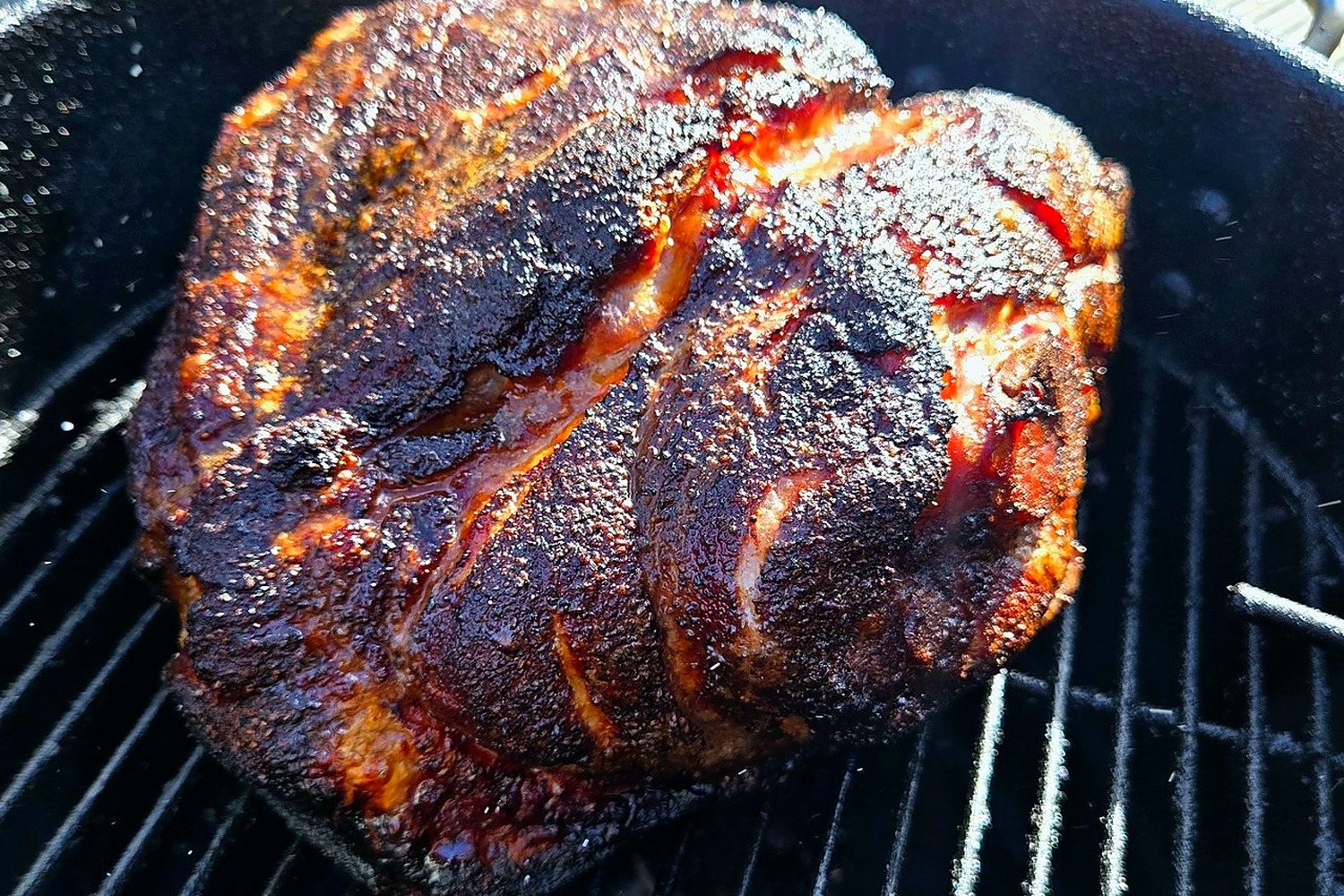
If your goal is bark, dry brine is usually the cleanest path. Why: it improves internal seasoning, it dries the surface which helps Maillard which helps bark, and it avoids soaking the outside in water right before you try to dehydrate it for bark.
Brining plus chicken skin
Wet brine can help chicken stay juicy, but it often hurts skin crisping unless you air dry after. For crisp, browned skin: brine, rinse or not based on salt level then pat dry, air dry uncovered in the fridge, and finish at higher heat at some point.
Smoke and brining
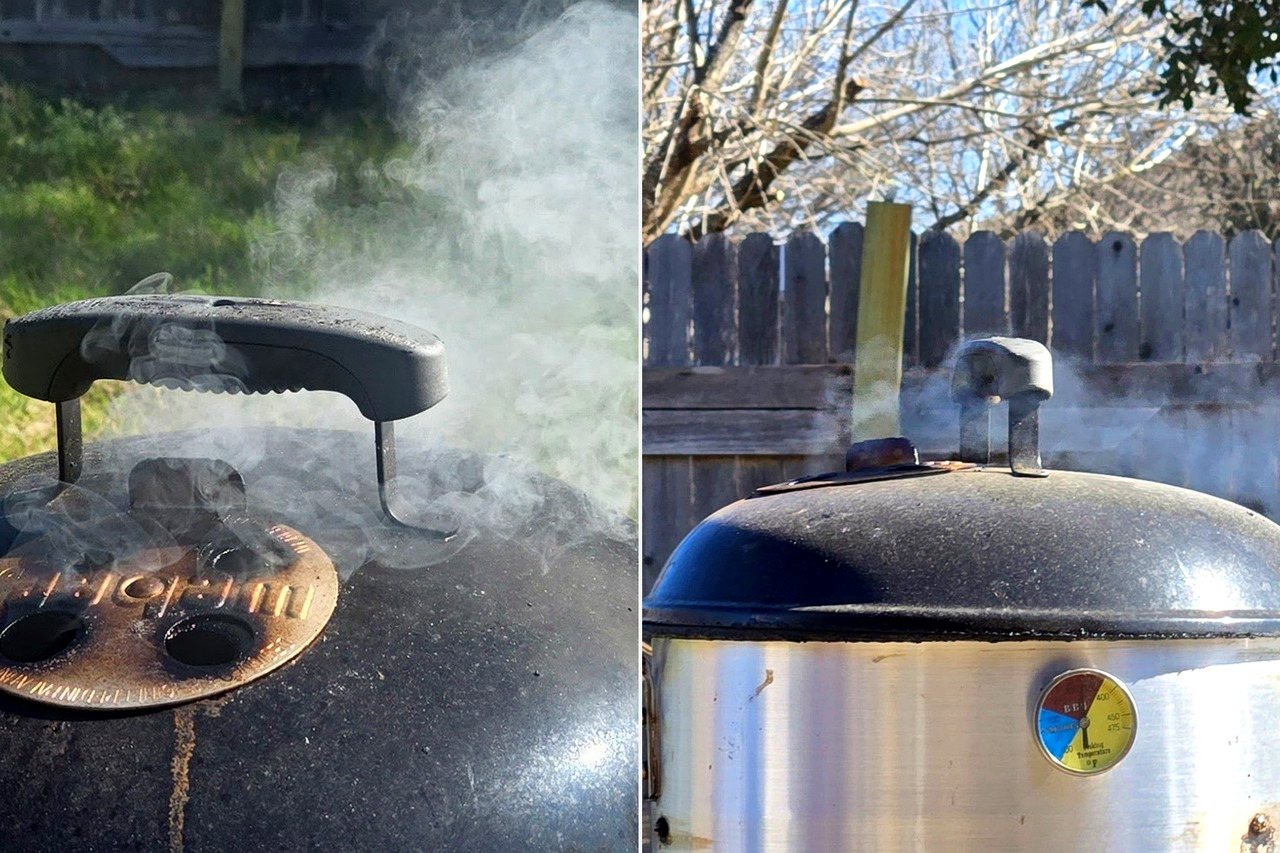
Brining does not replace clean smoke. If your smoke is dirty, it will sit on the surface and flatten flavors, brined or not.
Brining plus finishing heat
This is one of the best combos in BBQ: brine or dry brine for internal juiciness and seasoning, cook to doneness with controlled heat, then finish hot to trigger Maillard browning on the surface.
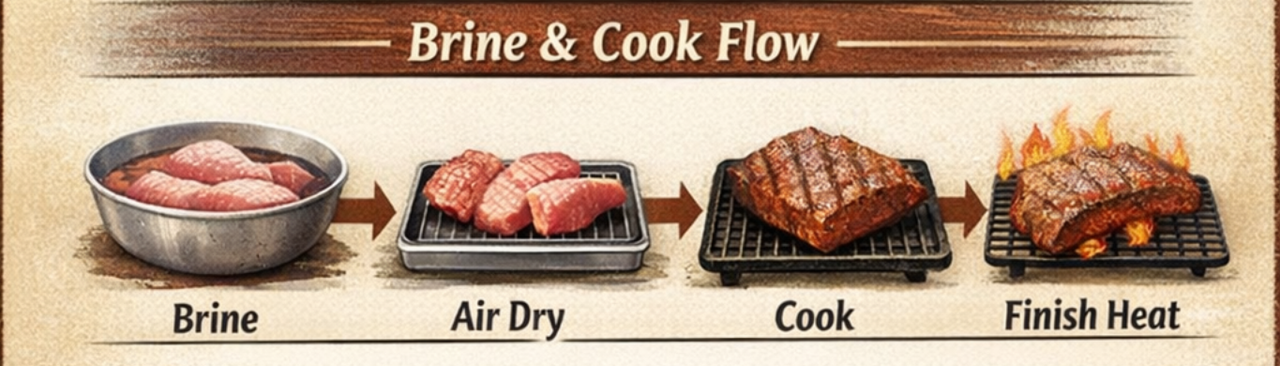
The complete brining workflow - brine, air dry, cook, finish with high heat
Troubleshooting… why brines go wrong
Problem: "It tastes like ham"
Cause: too much salt, too long, or curing salt used when it should not be.
Fix: reduce salt percentage, shorten time, and stop using Cure #1 unless you are doing an actual cured product.
Problem: "Skin won't crisp"
Cause: surface stayed wet, humidity stayed high, or it never got hot enough.
Fix: air dry uncovered, finish hot, and don't trap steam late in the cook.
Problem: "Bark won't set"
Cause: wet brine without drying, too much spritzing, cooker too humid, or wrapped too early.
Fix: dry brine instead, or dry the surface hard before it hits the pit, and delay wrapping until bark is set.
Problem: "Too salty"
Cause: salt percentage too high, time too long, or you used a cup based recipe with the wrong salt type.
Fix: switch to weighing salt, lower concentration, and shorten time.
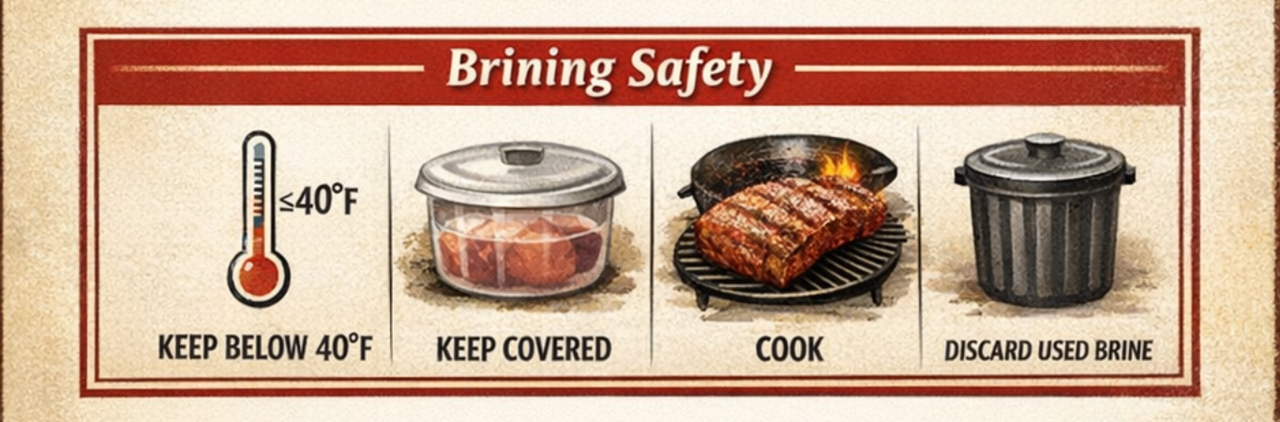
Critical brining safety rules - keep below 40°F, keep covered, cook thoroughly, discard used brine
Sources
USDA blog, brining safely, keep refrigerated at 40°F or less, avoid excessively long brines for poultry.
USDA FSIS, poultry brining and marinating guidance, refrigeration and safe handling.
FSIS Processing Inspectors' Calculations Handbook, nitrite and nitrate curing calculations and limits framework.
FSIS cured meat and poultry operations Q&A, noncompliance when nitrite exceeds allowable limits.
FSIS sausage operations quick reference, ppm equation and curing compound math framework.
Prague Powder #1 composition reference, 6.25% sodium nitrite and 93.75% salt, dyed pink to avoid confusion.
Keep learning